

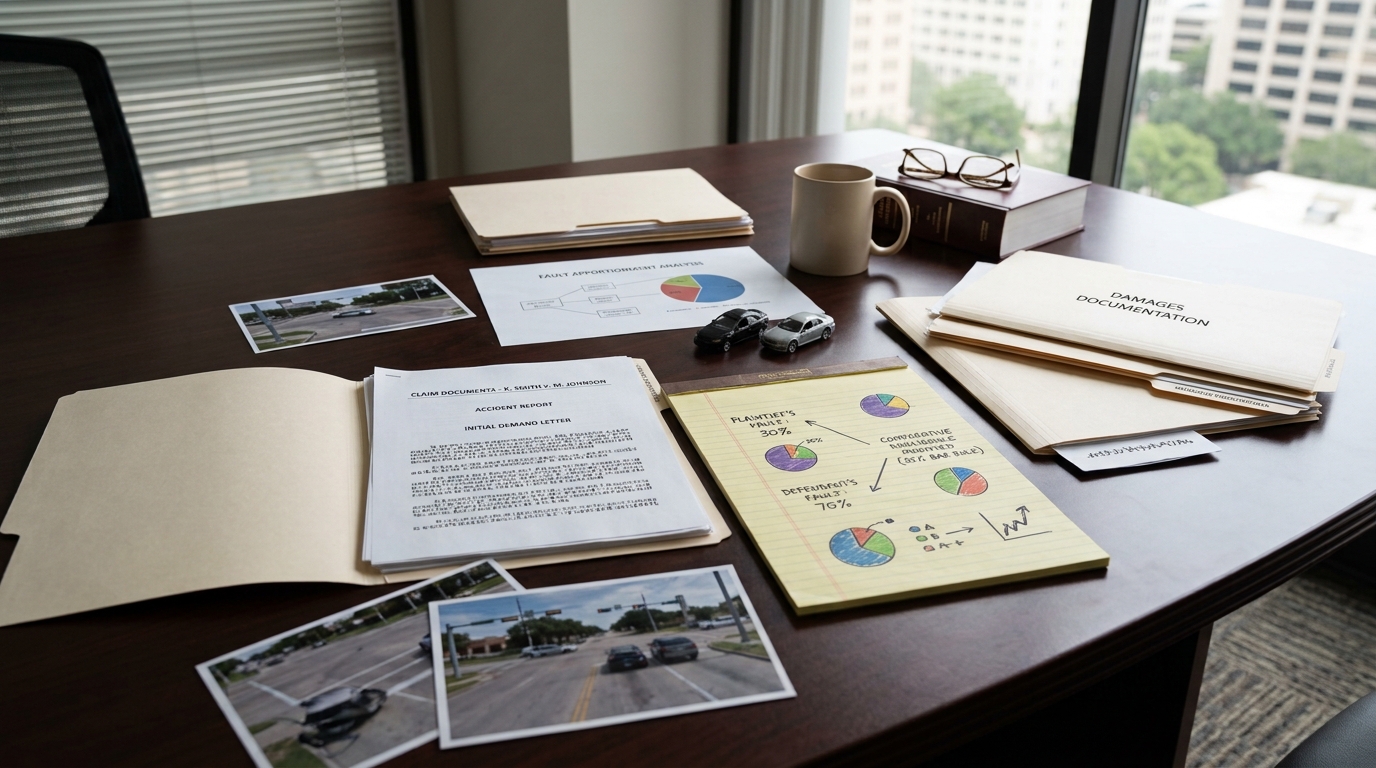
After an accident, many injured people assume the process is simple:
Someone else caused the crash, so they should pay for the damages.
Sometimes, responsibility is clear.
But many accidents are more complicated.
Insurance companies may argue that more than one person contributed to what happened.
A driver may have caused the main collision, but another person’s actions may also be questioned.
This is where comparative negligence becomes important.
Texas uses a modified comparative responsibility system that allows fault to be divided among parties in certain injury claims.
Understanding how this works can help Houston injury victims better understand:
- How fault is evaluated
- Why insurance companies investigate responsibility
- How evidence affects a claim
- How a percentage of fault may influence compensation
Quick Answer
Texas comparative negligence allows responsibility for an accident to be divided between parties based on their percentage of fault.
For example:
A court may determine:
- Driver A: 80% responsible
- Driver B: 20% responsible
The amount of damages recovered may be affected by the injured person’s percentage of responsibility.
Texas Civil Practice and Remedies Code Chapter 33 establishes the state’s proportionate responsibility rules.
Under Texas Civil Practice and Remedies Code §33.001, a claimant may not recover damages in an action to which the chapter applies if the claimant’s percentage of responsibility is greater than 50%.
The exact impact depends on the facts of each case.
What Is Comparative Negligence?
Comparative negligence is a legal system used to address situations where more than one person may have contributed to an injury.
Instead of asking only:
“Who caused the accident?”
the analysis may ask:
“How much responsibility does each person have?”
This matters because accidents are not always black and white.
Consider a Houston intersection crash.
One driver runs a red light.
Another driver is traveling above the speed limit.
The first driver may have created the main danger.
But investigators may also examine whether the second driver’s actions contributed.
The final responsibility analysis depends on the evidence.
Texas Uses Modified Comparative Responsibility
Texas follows a modified comparative responsibility approach.
This means an injured person’s recovery can be affected if they are found partly responsible for their own injuries.
Texas law does not treat every accident as a simple winner-or-loser situation.
Instead, responsibility may be divided.
The process considers:
- Each person’s actions
- The circumstances of the accident
- Available evidence
- Applicable legal standards

Why Comparative Negligence Matters In Houston Injury Claims
Many injury claims involve disagreements about what happened.
An insurance company may argue:
- The injured person contributed to the accident
- Another driver was only partially responsible
- Certain damages should be reduced
The injured person may disagree.
This creates a question:
What evidence supports each side’s position?
Important evidence may include:
- Police reports
- Photos
- Videos
- Witness statements
- Vehicle damage
- Medical records
- Accident reconstruction information
Common Situations Where Fault May Be Disputed
Car Accidents
Vehicle crashes often involve questions about:
- Speed
- Following distance
- Lane changes
- Traffic signals
- Driver attention
Example:
A driver rear-ends another vehicle.
The following driver may appear responsible.
But the investigation may also consider whether the front driver suddenly stopped without reason.
The facts matter.
Truck Accidents
Commercial truck crashes can involve additional questions:
- Driver actions
- Company practices
- Vehicle maintenance
- Cargo loading
- Road conditions
Multiple parties may potentially be involved.
Slip And Fall Claims
Property injury claims may involve questions such as:
- Was there a dangerous condition?
- Was the property owner aware?
- Did the injured person notice the hazard?
- Did any actions contribute?
Pedestrian Accidents
Pedestrian accidents can involve complex questions about:
- Driver behavior
- Pedestrian movement
- Traffic signals
- Visibility
How Insurance Companies Use Comparative Negligence Arguments
Insurance companies investigate claims before making decisions.
One issue they may evaluate is whether the injured person contributed to the accident.
Examples of arguments may include:
- The injured person was distracted
- The injured person failed to follow safety rules
- The injured person acted in a way that increased risk
These arguments do not automatically determine fault.
They must be supported by evidence.
Evidence Often Determines Fault Percentages
Comparative negligence is not decided by assumptions.
Evidence matters.
Photos And Videos
Pictures may show:
- Vehicle positions
- Road conditions
- Damage patterns
- Traffic signals
Witness Statements
Independent witnesses may provide information about:
- What they observed
- Vehicle movements
- Timing of events
Police Reports
Reports may contain:
- Accident descriptions
- Officer observations
- Statements from involved parties
Medical Records
Medical documentation helps connect:
- The accident
- The injury
- The treatment

How Fault Percentages Can Affect Compensation
One of the most important parts of comparative negligence is that responsibility percentages can affect recovery.
Example:
A person suffers $100,000 in damages.
The investigation determines:
- Other driver: 80% responsible
- Injured person: 20% responsible
The final recovery may be affected by that percentage.
The exact calculation depends on the law, facts, and type of claim involved.
The 51% Rule In Texas
Texas law places an important limit on recovery.
Under Texas Civil Practice and Remedies Code §33.001, a claimant may not recover damages in an action governed by Chapter 33 if the claimant’s percentage of responsibility is greater than 50%.
This means a person found more than 50% responsible may be prevented from recovering damages under the statute.
Because fault percentages can significantly affect a claim, disputes about responsibility can become important.
Comparative Negligence Does Not Mean Everyone Is Automatically At Fault
A common misunderstanding is:
“If both people were involved, both must be responsible.”
That is not how the system works.
The question is whether evidence shows that a person’s actions contributed to the injury.
Being present at an accident does not automatically create legal responsibility.
How To Protect Your Injury Claim After An Accident
You cannot control every argument an insurance company makes.
But you can control how well your claim is documented.
Collect Evidence Early
Take photographs of:
- The accident scene
- Vehicle damage
- Road conditions
- Visible hazards
Seek Medical Care
Medical records help document:
- Symptoms
- Diagnoses
- Treatment
Be Accurate
Avoid guessing about details you do not remember.
Provide facts.
Keep Records
Save:
- Bills
- Receipts
- Insurance messages
- Reports
What Should You Avoid Saying After An Accident?
People often speak casually after crashes.
Statements that may create confusion include:
- “I wasn’t paying attention.”
- “I should have reacted faster.”
- “I guess it was partly my fault.”
Immediately after an accident, people may not know all the facts.
A better approach is to describe what happened without making conclusions.
Understanding Settlement Offers And Fault Disputes
Insurance companies may consider comparative negligence when evaluating settlement offers.
Before accepting a settlement, consider:
- How fault is being assigned
- What evidence supports that position
- Whether future losses are included
- Whether medical treatment is complete
A settlement should be evaluated based on the entire situation.

When A Houston Personal Injury Lawyer May Help
Not every accident requires legal representation.
Some claims may be handled through straightforward insurance processes.
However, legal guidance may be useful when:
- Fault is disputed
- Insurance companies deny responsibility
- Multiple parties are involved
- Injuries are serious
- Future medical treatment may be needed
- The settlement offer does not reflect documented losses
A houston personal injury lawyer may help review evidence and explain how Texas responsibility rules may apply.
Thompson Law also provides information through its personal injury lawyers resources.
Comparative Negligence Checklist After A Houston Accident
Accident Documentation
- Take photos
- Collect witness information
- Obtain reports
- Save videos
Medical Documentation
- Keep medical records
- Track appointments
- Save bills
- Follow treatment recommendations
Insurance Documentation
- Save claim communications
- Keep settlement offers
- Record conversations
- Organize documents
Fault Questions
- What evidence supports responsibility?
- Did another person contribute?
- Are insurance arguments supported by facts?
FAQ
Comparative negligence allows responsibility for an injury to be divided among parties based on their percentage of fault in applicable cases.
Possibly. Recovery depends on the percentage of responsibility assigned and the specific facts of the claim. Texas law limits recovery when a claimant is found more than 50% responsible in applicable cases.
Insurance companies investigate claims, but legal responsibility may ultimately depend on evidence, negotiations, or court decisions.
Photos, videos, witness statements, police reports, medical records, and other documentation may help explain what happened.
Legal guidance may be helpful when fault is disputed, injuries are significant, multiple parties are involved, or insurance issues become complicated.
Final Thoughts
Accidents are rarely as simple as they first appear.
A crash may involve:
- Multiple decisions
- Different perspectives
- Conflicting statements
- Complex evidence
Texas comparative negligence laws exist to address situations where responsibility is shared.
For injured people, understanding this system highlights the importance of documentation.
Take photos.
Keep records.
Follow medical advice.
Preserve evidence.
And understand how fault arguments may affect your claim.
For local resources, the Thompson Law Houston profile provides contact and location information.