

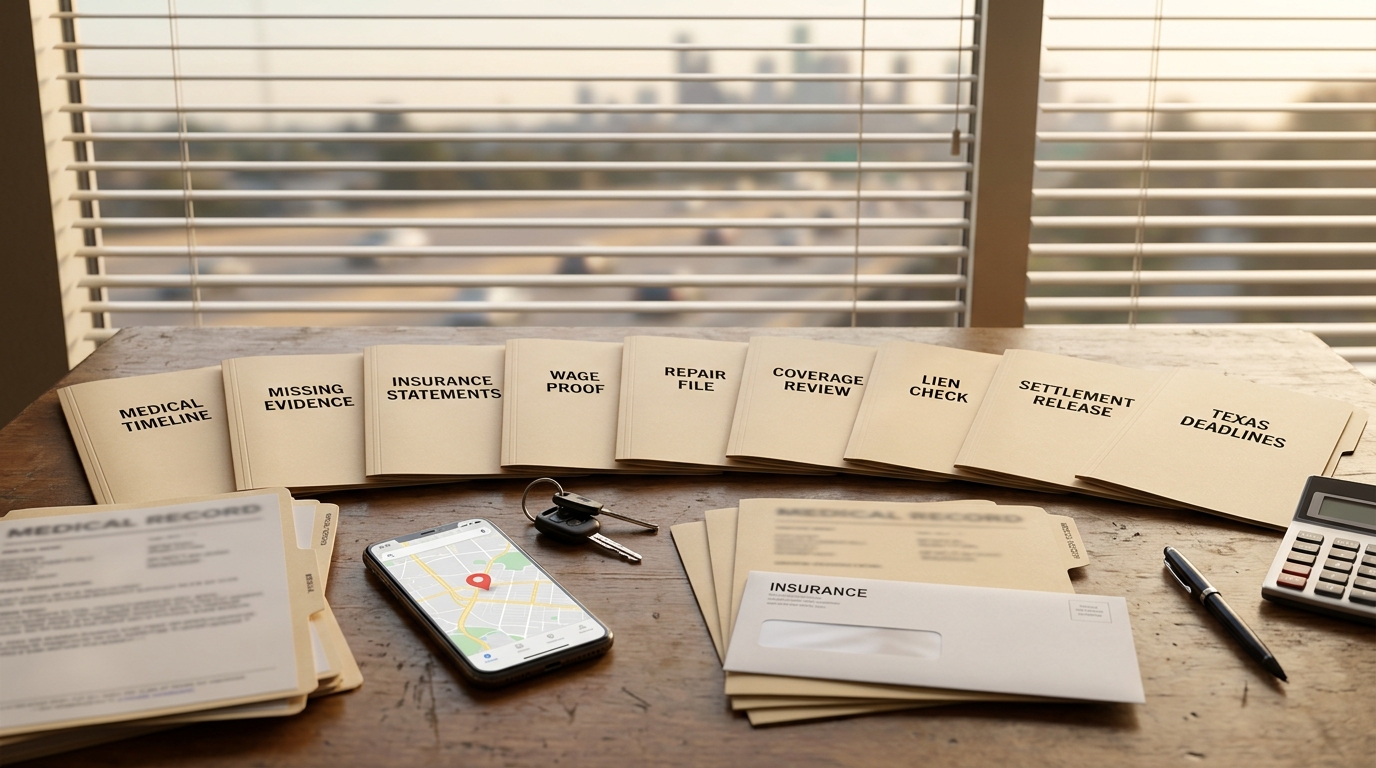
An injury settlement can lose value long before negotiation begins. The loss may not come from one big mistake. It may come from small leaks in the claim file: delayed medical care, missing photos, lost witness names, unclear insurance statements, weak wage proof, unrecovered camera footage, overlooked policy coverage, or a settlement release signed before treatment is complete.
After an accident in Houston, the insurance company may evaluate every part of the claim. It may review who caused the accident, what the crash report says, how quickly you got medical care, whether treatment was consistent, what records support lost wages, whether vehicle damage matches the injury claim, and whether Texas deadlines are approaching.
This guide explains common mistakes that reduce injury settlements, why they matter, and how Houston accident victims can protect the value of a claim before signing anything final.
Quick Answer
Common mistakes that reduce injury settlements include delaying medical care, missing follow-up appointments, failing to photograph the scene, losing witness information, not tracking the crash report, giving broad recorded statements, signing medical authorizations without limits, posting about the accident online, repairing the vehicle before documenting damage, failing to prove wage loss, overlooking UM/UIM or PIP coverage, ignoring liens, accepting a quick settlement, and waiting too long to ask about Texas deadlines.
If you were injured in Houston and are unsure whether a settlement offer reflects your medical bills, wage loss, future care, coverage, or evidence, speaking with an accident lawyer houston residents can contact may help you review the claim before value leaks become harder to fix.
Key Takeaways
- Injury settlements are often reduced because the claim file has gaps, contradictions, missing records, or unresolved damages.
- Medical timing matters. Delayed care, missed appointments, and unclear treatment records can give insurers arguments to reduce settlement value.
- Evidence matters. Photos, reports, witnesses, camera notes, repair records, and medical documentation can help answer fault and causation disputes.
- Insurance communication should stay factual. Guessing, minimizing injuries, or giving broad recorded statements can create problems later.
- Settlement releases should be reviewed carefully because they may end the claim before future treatment, liens, wage loss, or additional coverage are fully understood.
- Texas injury deadlines and shared-fault rules can affect settlement leverage.
The Houston Settlement Leak Audit
A settlement leak is anything that gives the insurance company a reason to delay, reduce, deny, or pressure the claim.
Use this audit board:
| Settlement Leak | How It Can Reduce Value | What To Do Instead |
| Delayed medical care | Insurer questions whether the accident caused the injury | Get evaluated and keep records |
| Treatment gaps | Insurer argues the injury improved or was not serious | Follow care instructions and document gaps |
| Missing photos | Fault and damage become harder to prove | Save scene, vehicle, and hazard photos |
| Lost witnesses | Disputed facts become harder to confirm | Collect names and phone numbers early |
| Weak wage proof | Lost income may be ignored or reduced | Save pay stubs, schedules, and employer letters |
| Recorded statement mistakes | Inconsistent statements may be used later | Keep answers factual and avoid guessing |
| Broad authorizations | Unrelated medical history may be reviewed | Ask for limited record requests |
| Early release | Future care or unresolved losses may be lost | Review settlement terms before signing |
| Overlooked coverage | Available benefits may go unused | Review all policies, not just the other driver’s |
| Missed timing issues | Deadline pressure weakens negotiation | Track Texas deadlines early |
The goal is not to create a perfect claim. The goal is to stop preventable leaks.
Leak 1: Waiting Too Long to Get Medical Care
One of the most common settlement leaks is delayed medical care.
After a crash, fall, or other injury event, adrenaline may hide symptoms. Pain can increase over hours or days. Neck pain, back pain, headaches, dizziness, numbness, shoulder pain, knee pain, sleep problems, anxiety, and tingling may not feel serious at first.
Insurance companies may use delayed care to argue:
- The injury was not caused by the accident.
- The injury was not serious.
- Something else caused the symptoms.
- Medical bills are unrelated.
- Treatment was unnecessary.
- The injured person exaggerated later.
What to do instead:
- Get medical care when symptoms appear.
- Tell the provider when the accident happened.
- Describe all symptoms clearly.
- Follow discharge instructions.
- Keep follow-up appointments.
- Save medical records and bills.
- Track symptoms that appear later.
Useful records may include emergency room records, urgent care notes, imaging reports, prescription receipts, referral paperwork, physical therapy notes, specialist reports, work restrictions, and medical bills.
Leak 2: Missing Follow-Up Care
Getting initial medical care is only the first step. A settlement can also lose value when follow-up care is inconsistent.
Insurers may focus on:
- Missed appointments
- Long gaps between visits
- Not following referrals
- Stopping therapy without explanation
- Failing to get recommended imaging
- Not reporting worsening symptoms
- Not asking for work restrictions
- Not documenting future care needs
A treatment gap does not always mean the claim is weak. People miss care for many reasons: transportation problems, cost, scheduling issues, work conflicts, childcare, or waiting for referrals. But undocumented gaps create openings for insurance arguments.
What to do instead:
- Reschedule missed appointments.
- Document why a gap happened.
- Keep referral paperwork.
- Save appointment confirmations.
- Ask doctors to document restrictions.
- Keep a simple treatment timeline.
A clear medical timeline helps show how symptoms, treatment, and recovery developed.

Leak 3: Failing to Photograph the Scene
Photos can protect settlement value because they preserve facts before the scene changes.
If safe, photograph:
- Vehicle damage
- License plates
- Final vehicle positions
- Road layout
- Lane markings
- Traffic signs
- Traffic signals
- Crosswalks
- Skid marks
- Debris
- Paint transfer
- Broken glass
- Weather and lighting
- Construction barrels or lane shifts
- Nearby businesses
- Nearby cameras
- Visible injuries
- Damaged personal property
For unsafe property injuries, photograph:
- Spills
- Broken pavement
- Poor lighting
- Missing warnings
- Loose mats
- Damaged stairs
- Uneven sidewalks
- Parking-lot hazards
- Store aisles
- Apartment or hotel conditions
- Warning signs or lack of warnings
Without photos, insurers may argue there is not enough proof of how the accident happened, what the damage looked like, or what hazard existed.
Do not risk your safety for photos. But if you can document safely, do it early.
Leak 4: Losing Witnesses and Camera Leads
Witness and camera evidence can be settlement leverage. It can also disappear quickly.
Witnesses may include:
- Other drivers
- Passengers
- Pedestrians
- Cyclists
- Store employees
- Apartment staff
- Hotel employees
- Restaurant workers
- Parking attendants
- Security guards
- Rideshare passengers
- Delivery drivers
- Nearby residents
Ask for names and phone numbers before witnesses leave.
Also look for cameras near:
- Gas stations
- Retail centers
- Apartment entrances
- Restaurants
- Hotels
- Parking garages
- Office buildings
- Hospitals
- Warehouses
- Construction corridors
- Freeway-adjacent businesses
- Doorbell cameras
- Dashcams
- Rideshare or delivery vehicles
Write down the business name, address, camera direction, and approximate crash time. Do not assume footage will be saved automatically.

Leak 5: Not Tracking the Crash Report
A crash report can help document the accident date, time, location, drivers, vehicles, insurance information, reported injuries, witnesses, citations, contributing factors, and officer observations.
For Houston crashes, the Houston Police Department describes an accident or crash report as a Texas Peace Officers’ Accident Report completed by a Houston police officer and filed with TxDOT. HPD also explains that accident reports require processing time before public availability.
TxDOT is the custodian of Texas crash records and provides eligible requesters access to Texas Peace Officer’s Crash Reports through the Crash Report Online Purchase System.
Save:
- Report number
- Responding agency
- Officer name, if known
- Crash date
- Crash time
- Crash location
- Driver and vehicle information
- Insurance information
- Witness information
- Citation details, if any
- Notes about how the report was requested
A crash report helps, but it is not the whole settlement file. Your photos, medical records, repair estimates, witness details, wage proof, and insurance letters may also matter.
Leak 6: Guessing During Insurance Calls
Insurance calls can reduce settlement value when answers are vague, inaccurate, or overly broad.
Avoid guessing about:
- Speed
- Distance
- Timing
- Visibility
- Vehicle movement
- Fault
- Injury severity
- Whether you are fully recovered
- Future medical care
- Treatment cost
- Lost wage totals
- Whether prior pain is related
If you do not know, say you do not know.
Keep communication factual:
- Date
- Location
- Vehicles involved
- Police response
- Claim number
- Basic contact information
- Medical care received
- Vehicle location
- Repair status
Keep a call log with the adjuster’s name, insurance company, phone number, email address, call date, and what was discussed.
Leak 7: Giving a Recorded Statement Without Preparation
A recorded statement may be compared with crash reports, medical records, photos, witness statements, repair notes, and later testimony.
A statement can reduce settlement value if you:
- Minimize symptoms
- Guess about speed or timing
- Admit fault without context
- Say you are “fine”
- Say treatment is finished when it is not
- Forget important details
- Give inconsistent answers
- Answer questions you do not understand
- Discuss unrelated medical history
Before giving a recorded statement, understand who is asking, why it is needed, whether your policy requires cooperation, whether the other driver’s insurer is asking, and what topics will be covered.
Leak 8: Signing Broad Medical Authorizations
Insurance companies may ask for medical authorizations. Some requests are limited to accident-related treatment. Others may be broad enough to reach unrelated medical history.
Be careful with authorizations that allow access to:
- Old injuries unrelated to the claim
- Entire medical history
- Unrelated providers
- Mental health records unrelated to the accident
- Pharmacy records unrelated to the injury
- Records before the relevant period
- Any provider without limits
Ask what records are needed and whether the request can be limited to accident-related treatment.
Leak 9: Repairing the Vehicle Before Documenting Damage
Vehicle damage can affect both property damage and injury settlement discussions.
Before repairs, photograph:
- All sides of the vehicle
- Close-ups of impact areas
- Broken lights
- Paint transfer
- Wheel damage
- Airbag deployment
- Interior damage
- Child seats
- Damaged personal property
- Odometer and dashboard warnings, if relevant
Save:
- Repair estimates
- Supplemental repair estimates
- Body shop invoices
- Total-loss valuations
- Rental receipts
- Towing bills
- Storage bills
- Communications with repair shops
- Communications with insurers
Insurance companies may argue that minor visible vehicle damage means the injury should also be minor. Detailed repair documentation can help answer that argument.
Leak 10: Not Documenting Lost Wages and Daily Impact
Settlement value may be reduced when financial losses are not documented.
Save:
- Pay stubs
- Timesheets
- Employer letters
- Missed-shift confirmations
- Work restriction notes
- Tax records
- Contractor invoices
- Business income records
- Proof of used sick time or vacation time
- Reduced-duty notes
- Out-of-pocket receipts
- Medical travel receipts
- Parking receipts for appointments
- Childcare receipts related to appointments
- Receipts for help at home
Also keep a short recovery journal. Track pain levels, sleep problems, mobility limits, headaches, medication effects, difficulty driving, missed activities, and changes in family responsibilities.
Keep it factual. A few dated notes each week are more useful than dramatic summaries written months later.

Leak 11: Ignoring Your Own Insurance Coverage
Many injured people focus only on the other driver’s insurance. That can reduce recovery options.
Your own policy may matter if:
- The other driver has no insurance
- The other driver does not have enough insurance
- The driver fled
- The other insurer delays
- Fault is disputed
- Medical bills are immediate
- Vehicle repairs are urgent
- You need a rental car
Coverage that may matter includes:
- Personal injury protection
- Medical payments coverage
- Uninsured motorist coverage
- Underinsured motorist coverage
- Collision coverage
- Rental reimbursement
- Health insurance
The Texas Department of Insurance explains that medical payments, personal injury protection, and UM/UIM coverage may help with medical bills depending on the policy and facts.
Do not assume there is no additional coverage until every available policy has been reviewed.
Leak 12: Forgetting About Liens and Reimbursement Claims
A settlement offer is not always the same as the final amount an injured person keeps.
Settlement funds may need to account for:
- Health insurance reimbursement
- Medicare or Medicaid issues
- Hospital liens
- Provider balances
- Letter-of-protection balances
- Workers’ compensation reimbursement
- PIP or MedPay coordination
- Medical bill reductions
- Case costs, if represented
- Attorney fees, if represented
Ignoring liens can create settlement delays or unexpected deductions. Before settlement, ask what bills, liens, reimbursements, or balances may need to be resolved.
Leak 13: Accepting the First Settlement Offer Too Quickly
A quick settlement may feel helpful when bills are arriving. But early offers often come before the full injury picture is clear.
Before accepting, ask:
- Is treatment complete?
- Are all medical bills included?
- Is future care expected?
- Are lost wages included?
- Are repair or rental issues separate?
- Are liens or reimbursement claims possible?
- Does the release cover all claims?
- Does the release include unknown injuries?
- Does it release only one party or multiple parties?
- Is the payment final?
- Does it affect UM/UIM claims?
- Does it affect property damage claims?
A settlement release can end the claim. Once signed, you may not be able to come back later for additional medical bills or future symptoms.
The TDI auto insurance guide warns that when another driver’s insurer offers a medical settlement, the insurer will ask for a release promising not to file more claims for the accident. Future medical treatment should be considered before signing.
Leak 14: Posting About the Accident Online
Social media can reduce settlement value when posts are taken out of context.
Avoid posting:
- Accident details
- Injury updates
- Crash photos
- Comments about fault
- Comments about settlement
- Jokes about the accident
- Check-ins during recovery
- Photos that can be misunderstood
- Arguments with the other party
- Updates about treatment or negotiations
Even innocent posts can be misread. It is safer to keep claim details offline until the case is resolved.
Leak 15: Waiting Too Long to Ask About Deadlines
Texas injury claims are time-sensitive. In many cases, a personal injury lawsuit must be brought not later than two years after the day the cause of action accrues under Texas Civil Practice and Remedies Code Section 16.003.
Some claims may involve shorter notice issues. If a governmental unit may be involved, Texas Civil Practice and Remedies Code Section 101.101 provides that a governmental unit is entitled to receive notice of a claim under the Texas Tort Claims Act not later than six months after the incident. City charter or ordinance notice rules may also matter in some cases.
Texas law also affects settlement leverage when fault is disputed. Under Texas Civil Practice and Remedies Code Section 33.001, a claimant may not recover damages if their percentage of responsibility is greater than 50 percent.
Settlement negotiations do not automatically stop deadlines. Do not wait until time is almost gone.
Leak 16: Assuming the Insurance Company Counts Everything
Insurance companies may not count every loss unless it is documented.
Do not assume the adjuster knows about:
- Future appointments
- New symptoms
- Work restrictions
- Missed shifts
- Reduced income
- Transportation costs
- Home help
- Childcare expenses
- Medical equipment
- Unpaid medical balances
- Health insurance reimbursement
- Total-loss disputes
- Rental gaps
- Out-of-pocket expenses
- Pain that affects daily routines
A settlement demand should tell the full documented story, not just list medical bills.
Houston Accident Settings Where Settlement Leaks Happen Fast
Houston accident claims can lose value quickly when evidence is not preserved early.
Freeways, Tollways, and Ramps
Crashes on I-45, I-10, I-69/US 59, Loop 610, Beltway 8, US 290, SH 288, Westpark Tollway, Hardy Toll Road, and freeway ramps may involve high speeds, lane changes, sudden stops, commercial vehicles, and multi-vehicle impacts.
Evidence leaks may include missing dashcam footage, lost witnesses, unclear lane details, repaired vehicles, and delayed crash reports.
Downtown, Galleria, Medical Center, and Airport-Area Crashes
Dense areas may involve rideshare pickups, pedestrians, scooters, delivery vehicles, buses, parking garages, hotels, valet zones, and business cameras.
Evidence leaks may include overwritten camera footage, missing trip receipts, unclear pickup locations, lost witness names, and incomplete scene photos.
Parking Lots, Apartments, Stores, and Restaurants
Parking-lot and property-adjacent injury claims may involve backing vehicles, poor lighting, spills, broken pavement, missing warnings, or unclear right-of-way.
Evidence leaks may include missing incident reports, cleaned hazards, lost surveillance footage, and weak witness documentation.
Commercial, Truck, and Delivery Vehicle Claims
Commercial vehicle claims may involve company records, maintenance files, driver information, dispatch logs, electronic data, and multiple insurance policies.
Evidence leaks may include unpreserved company video, incomplete vehicle markings, missing USDOT information, and delayed coverage review.
Houston’s Vision Zero commitment to ending traffic deaths and serious injuries underscores why local roadway context, serious-injury documentation, and location details may matter in injury claims.
Settlement Leak Audit Checklist
Use this checklist before accepting an offer.
Medical File
- Have all records been requested?
- Are all bills included?
- Is treatment complete?
- Is future care expected?
- Are work restrictions documented?
- Are treatment gaps explained?
Evidence File
- Are scene photos saved?
- Are vehicle or hazard photos saved?
- Are witness names preserved?
- Are camera locations documented?
- Is the crash or incident report tracked?
- Is damaged property preserved?
Insurance File
- Are claim numbers saved?
- Are adjuster letters saved?
- Are coverage letters reviewed?
- Is your own policy reviewed?
- Are UM/UIM, PIP, MedPay, collision, and rental issues checked?
- Are recorded statement requests documented?
Financial File
- Are wage losses documented?
- Are repair estimates saved?
- Are rental and towing receipts saved?
- Are out-of-pocket costs included?
- Are liens or reimbursement claims identified?
Settlement File
- Has release language been reviewed?
- Does the offer include all damages?
- Does the release affect unknown injuries?
- Does it release all parties?
- Are Texas deadlines tracked?
- Are public-entity notice issues possible?
When Legal Guidance May Be Useful
Not every settlement requires a lawyer. But legal guidance may be useful when mistakes, missing records, disputed fault, or insurance pressure create risk.
Consider asking for legal guidance if:
- You were injured
- Medical treatment is ongoing
- You delayed care but symptoms continue
- Fault is disputed
- The insurer blames you
- You gave a recorded statement
- You received broad medical authorization forms
- Camera footage may exist
- Witnesses need to be contacted
- The other driver fled
- The other driver had no insurance
- A commercial vehicle was involved
- A rideshare or delivery driver was involved
- A child was injured
- A loved one died
- You received a low settlement offer
- Liens or reimbursement claims are unclear
- You are close to a deadline
- A government vehicle or public property issue may be involved
A lawyer may help organize the record, identify missing evidence, review coverage, respond to fault arguments, communicate with insurers, evaluate damages, review release language, and explain Texas timing issues.
FAQ
What mistakes reduce injury settlements?
Common mistakes include delaying medical care, missing appointments, failing to preserve photos or witnesses, giving broad recorded statements, signing medical authorizations without limits, ignoring wage proof, overlooking coverage, accepting a quick settlement, and waiting too long to ask about deadlines.
Can delayed medical care reduce my settlement?
Yes. Insurance companies may argue that delayed medical care means the injury was not serious or was not caused by the accident.
Can missing photos hurt settlement value?
Yes. Photos can show vehicle damage, road layout, hazards, lighting, signs, debris, and property conditions before the scene changes.
Should I give a recorded statement?
Be careful. A recorded statement may be compared against reports, photos, medical records, witnesses, and later statements. Understand who is asking and why before agreeing.
Why should I document lost wages?
Insurers may not count missed work unless it is supported by records such as pay stubs, timesheets, employer letters, tax records, work restrictions, or missed-shift confirmations.
What if I already accepted an early offer?
It depends on whether a release was signed and what the release says. If you accepted or signed anything, keep copies and ask for guidance before assuming additional claims remain open.
Why do liens matter in a settlement?
Liens and reimbursement claims may affect the final amount distributed after settlement. Medical providers, health insurers, Medicare, Medicaid, or other payors may assert repayment interests depending on the facts.
Can social media reduce settlement value?
Yes. Posts, photos, comments, and check-ins can be taken out of context and used to question injury severity, activity level, or credibility.
How long do I have to file a personal injury lawsuit in Texas?
In many Texas injury cases, the general deadline is two years from when the cause of action accrues. Some claims may involve shorter notice rules or different deadlines.
Is this article legal advice?
No. This article is for general informational purposes only. Anyone dealing with a specific accident, injury claim, settlement offer, or release should speak with a qualified legal professional about their situation.
Final Thoughts
Injury settlements are reduced when value leaks out of the claim file. Delayed care, missing evidence, weak wage proof, insurance statement mistakes, overlooked coverage, unresolved liens, early releases, and deadline pressure can all change the outcome.
The best way to protect a Houston injury settlement is to audit the file before signing: medical records, photos, reports, witnesses, cameras, repairs, wage proof, coverage, liens, release language, and Texas deadlines. A settlement should be based on the full documented claim, not just the first offer.