


A car accident can be overwhelming.
Immediately afterward, many people focus on practical concerns:
- Is everyone safe?
- Is the vehicle damaged?
- Do I need to contact insurance?
- How will I get home?
One question is often overlooked:
“Should I get evaluated for possible injuries?”
Some accident-related symptoms are obvious immediately.
Others may develop hours or days later.
That is why seeking appropriate medical evaluation after a collision can be an important step—even if you initially feel fine.
For people searching for an Injury Doctor Fort Worth, understanding when and why evaluation matters can help you make more informed decisions after an accident.
Why People Sometimes Delay Medical Evaluation
After a collision, people often underestimate their injuries.
There are several reasons this happens.
Adrenaline Can Mask Symptoms
A crash can trigger a stress response.
Immediately afterward, your body may release hormones that temporarily reduce your awareness of discomfort.
You may feel:
- Shaken
- Alert
- Focused on the situation
- Less aware of soreness
Later, once things settle down, symptoms may become more noticeable.
Some Injuries Develop Gradually
Not every injury announces itself immediately.
You may leave the accident scene feeling normal and later experience:
- Neck stiffness
- Back discomfort
- Headaches
- Shoulder soreness
- Reduced movement
- Muscle tightness
Delayed symptoms do not automatically mean a serious injury.
However, changes after an accident deserve attention.
People Hope Symptoms Will Go Away
Some individuals wait because they think:
“It is probably just soreness.”
Sometimes symptoms improve.
Other times, waiting can delay appropriate evaluation and recovery planning.
What Immediate Evaluation Can Help Identify
An injury evaluation helps you understand what may be happening after the collision.
Depending on your symptoms, a healthcare professional may assess:
- Where discomfort is located
- When symptoms began
- How the accident occurred
- Range of motion
- Strength
- Sensation
- Movement patterns
- Functional limitations
The goal isn’t simply to identify what hurts.
It is to understand how the injury may be affecting your ability to function.
Common Symptoms That Should Not Be Ignored
After an accident, pay attention to changes involving:
Neck Symptoms
Common complaints include:
- Stiffness
- Limited movement
- Pain when turning the head
- Upper shoulder discomfort
Back Symptoms
Back-related issues may affect:
- Sitting
- Standing
- Walking
- Bending
- Lifting
Headaches
Headaches after a collision can have different causes.
They deserve additional attention when combined with:
- Dizziness
- Confusion
- Balance problems
- Memory changes
- Vision issues
Muscle and Soft Tissue Symptoms
You may notice:
- Tightness
- Tenderness
- Soreness
- Reduced flexibility
Changes in Daily Activities
A useful question is:
“What can I no longer do comfortably that I could do before?”
Examples include:
- Driving
- Working
- Sleeping
- Exercising
- Household activities
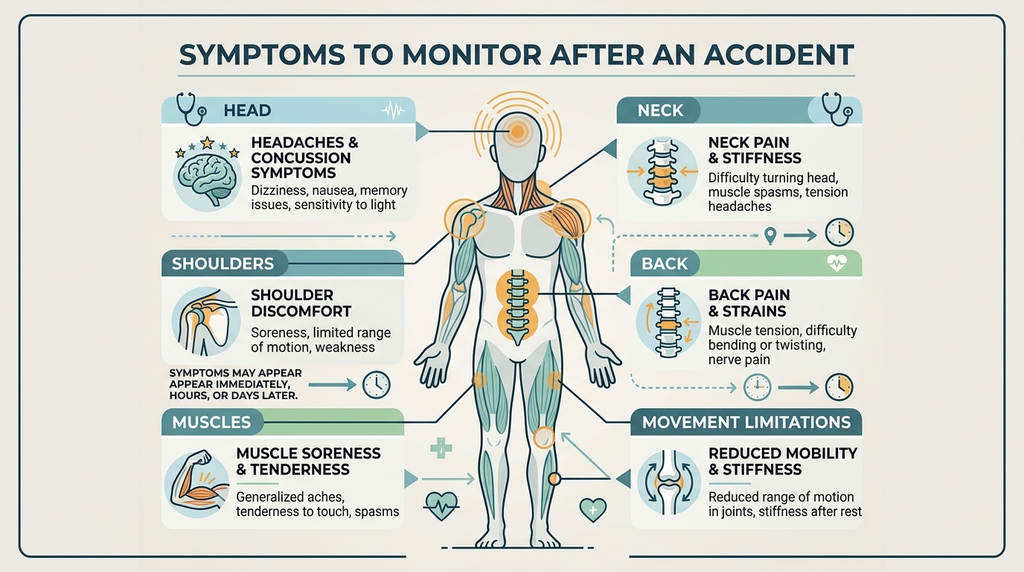
Understanding Delayed Accident Symptoms
One of the biggest reasons people delay care is because they expect injuries to appear immediately.
That is not always the case.
The CDC explains that concussion symptoms may appear immediately or develop hours or days after an injury. Symptoms may involve physical, cognitive, emotional, and sleep-related changes. CDC Traumatic Brain Injury Symptoms
Similarly, musculoskeletal discomfort may become more noticeable after normal activities resume.
For example:
Day of accident: You feel mostly normal.
Next morning: Your neck feels stiff.
Several days later: Sitting at work becomes uncomfortable.
Following week: You notice difficulty exercising or sleeping.
Tracking these changes can provide useful information during an evaluation.
When Emergency Care Should Come First
Immediate medical evaluation does not always mean a routine appointment.
Some situations require emergency care.
The CDC identifies several warning signs after possible traumatic brain injury, including:
- Worsening headache
- Repeated vomiting
- Increasing confusion
- Unusual behavior
- Difficulty waking
- Weakness or numbness
- Seizures
- Loss of consciousness
CDC Brain Injury Warning Signs
If these symptoms occur, seek emergency medical attention.
A responsible healthcare approach begins by identifying the right level of care.
What Happens During an Injury Evaluation?
Many people are unsure what to expect when visiting an injury doctor after a collision.
An evaluation may include:
Reviewing the Accident
Understanding how the collision happened provides important context.
Questions may include:
- When did the accident occur?
- Where was the impact?
- What position was your body in?
- Did symptoms appear immediately?
Discussing Symptoms
A provider may ask:
- Where do you feel discomfort?
- When did symptoms begin?
- What activities make symptoms worse?
- What activities are more difficult now?
Evaluating Movement
Assessment may include:
- Range of motion
- Functional movement
- Strength
- Sensation
Understanding Daily Limitations
A complete evaluation should consider how symptoms affect your life.
Can you:
- Drive comfortably?
- Work normally?
- Sleep well?
- Exercise?
- Perform daily tasks?
These details help create a clearer picture.
Why Documentation Matters After an Accident
Early evaluation can also help establish a clearer record of what changed after the collision.
Important details to track include:
- Date of accident
- Symptoms noticed
- Activities affected
- Changes over time
- Treatments received
- Progress or setbacks
Clear communication helps healthcare providers understand the situation more completely.
How Chiropractic Care May Fit Into Recovery
Some people seek an Injury Doctor Fort Worth after an accident because they are experiencing musculoskeletal symptoms.
Chiropractic care may be considered for certain conditions involving the muscles, joints, and movement system.
The National Center for Complementary and Integrative Health explains that chiropractic care may include patient history, examination, diagnosis, treatment, and progress monitoring. NCCIH Chiropractic Overview
The appropriate approach depends on:
- The individual’s condition
- Symptoms
- Medical history
- Functional limitations
Chiropractic Treatment Is Individualized
Not every accident-related complaint requires the same treatment.
Depending on the patient’s needs, care may include:
- Manual techniques
- Mobility exercises
- Therapeutic exercise
- Rehabilitation strategies
- Movement education
- Activity modification
NCCIH explains that spinal manipulation involves a controlled thrust applied to a spinal joint, while spinal mobilization involves movement within the joint’s natural range without a thrust. NCCIH Spinal Manipulation Information
A provider should determine whether a particular approach is appropriate.
Why Rehabilitation Can Be Important
Many people think recovery means simply reducing pain.
However, recovery is also about restoring function.
Rehabilitation may focus on:
- Mobility
- Strength
- Balance
- Coordination
- Endurance
- Movement control
- Returning to normal activities
For example:
A driver recovering from a neck injury may want to turn their head comfortably again.
A worker recovering from back discomfort may want to sit through the workday.
A parent recovering from an accident may want to return to normal household activities.
Recovery goals are personal.

Choosing The Right Injury Doctor In Fort Worth
If you are researching an injury provider after an accident, consider:
Evaluation Approach
Does the provider assess your condition before recommending care?
Communication
Does the provider explain what they are evaluating and why?
Experience
Does the provider understand accident-related injuries?
Recovery Planning
Does the provider consider rehabilitation and functional goals?
Safety
Does the provider recognize when additional medical evaluation is necessary?
These factors are often more important than simply choosing the closest office.
Questions To Ask Before Your First Visit
Consider asking:
What will the first evaluation include?
What could be contributing to my symptoms?
Is this type of care appropriate for my condition?
How will progress be measured?
What activities should I modify?
What symptoms require urgent medical attention?
When should my treatment plan be reassessed?
Good communication helps patients make informed decisions.
Safety Considerations
NCCIH reports that spinal manipulation may cause temporary side effects such as increased pain or discomfort, stiffness, and headache. Serious complications are rare, but it’s important to discuss health conditions and medications with a provider. NCCIH Spinal Manipulation Safety
Before treatment, share information about:
- Previous injuries
- Existing medical conditions
- Current medications
- Neurological symptoms
- Changes in strength
- Changes in sensation
Complete information allows providers to make better-informed decisions.
Local Fort Worth Injury Resource
For people searching for an Injury Doctor Fort Worth after an accident, Premier Injury Clinics of DFW provides accident-focused chiropractic and rehabilitation services.
Learn more about the Fort Worth injury chiropractic location to review available services.
When comparing providers, consider:
- Evaluation process
- Accident experience
- Treatment options
- Rehabilitation support
- Communication
- Safety practices
Frequently Asked Questions
Why is immediate medical evaluation important after a car accident?
Evaluation can help identify injuries, document symptoms, and determine the appropriate type of care.
Can I be injured even if I feel fine after an accident?
Yes. Some symptoms may appear later as your body responds to the collision.
What symptoms should I watch for after an accident?
Neck stiffness, back discomfort, headaches, shoulder symptoms, reduced mobility, dizziness, numbness, and changes in daily functioning may warrant evaluation.
Should I see an injury doctor after every accident?
Not every accident requires the same level of care. Serious symptoms require emergency attention, while other complaints may require an appropriate evaluation.
Can chiropractic care help after an accident?
For certain musculoskeletal conditions, chiropractic care may be part of a conservative recovery plan. The appropriate approach depends on the individual’s condition.
What should I bring to an injury evaluation?
Bring information about the accident, symptoms, medical history, medications, previous injuries, and any changes in daily activities.
When should I seek emergency care?
Seek immediate medical attention for symptoms such as worsening headache, repeated vomiting, confusion, seizures, loss of consciousness, weakness, numbness, or difficulty waking.
Final Takeaway
Immediate medical evaluation after an accident is not about assuming the worst.
It is about understanding what happened, identifying important symptoms, and making informed decisions about recovery.
Some injuries are obvious.
Others develop gradually.
The sooner you understand what is happening, the easier it is to choose the right next steps.
For people searching for an Injury Doctor Fort Worth, Premier Injury Clinics of DFW is one local resource to consider.
A strong recovery plan begins with evaluation, communication, and care designed around the individual’s needs.